When San Antonio homeowners and commercial operators compare epoxy flooring and tile, the first instinct is to look at the upfront installation cost. That’s the wrong metric. Flooring is a long-term asset, and the right comparison includes lifetime cost of ownership — installation, maintenance, repairs, and replacement — over a 15- to 20-year period. When you run those numbers, the comparison between epoxy and tile often surprises people who assumed tile was the conservative, cost-effective choice.
Head-to-Head: Epoxy vs. Tile Across Key Metrics
| Factor | Quality Epoxy System | Ceramic / Porcelain Tile |
|---|---|---|
| Install cost (residential, per sq ft) | $4 – $9 | $6 – $15 (tile + labor + setting materials) |
| Grout lines | None — fully seamless | Yes — every tile has grout joints |
| Annual maintenance cost (per sq ft) | $0.05 – $0.25 | $0.50 – $1.50 (grout cleaning, re-grouting) |
| Chemical resistance | Excellent | Tile: good; grout: poor |
| Slip resistance (wet) | Good – Excellent (with aggregate) | Moderate (depends on tile texture) |
| Impact resistance | Excellent (flexible polymer) | Poor – chips, cracks on hard impact |
| Lifespan | 15 – 20+ years | Tile: 20+ years; grout: 5–10 years (re-grout) |
| Re-grout / maintenance cost (20 yr) | $0 (maintenance topcoat optional) | $1.50 – $4.00/sq ft every 7–10 years |
| Repair ease | Spot repair with matching materials | Difficult (color/dye lot matching rare) |
The Grout Problem: Tile’s Permanent Liability
Every tile floor is only as good as its grout — and grout is the weakest link in the system. Grout is porous, stains easily, harbors bacteria and mold, and degrades with repeated exposure to cleaning chemicals. Over a 20-year period, most tile floors require re-grouting at least once, sometimes twice. Professional re-grouting of a kitchen or bathroom runs $2–$5 per square foot. Add the annual cost of grout cleaners, sealers, and professional cleaning services, and the “affordable” tile floor becomes significantly more expensive than its installation price suggested.
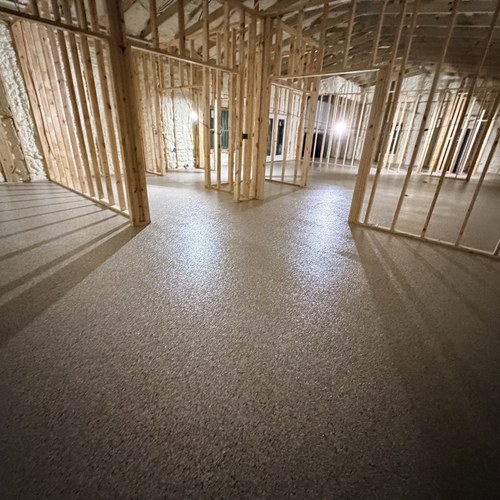
Epoxy has no grout. The continuous, seamless surface cleans in one pass without tools, brushes, or specialty chemicals. This isn’t a minor convenience — it’s a structural advantage that compounds over the life of the floor.
Where Tile Still Makes Sense
Tile has genuine advantages in specific applications: wall surfaces (epoxy isn’t a wall coating), areas that get extremely hot (tile won’t melt — relevant near fireplaces or outdoor grills at extreme heat), and in applications where the stone or ceramic aesthetic is required by design intent. Tile is also a familiar, widely understood product that appraisers and buyers recognize. But for floors that face cleaning demands, chemical exposure, foot traffic, and the desire for low ongoing maintenance — epoxy wins on nearly every metric that matters over the long run.
Total Cost of Ownership: A 20-Year Comparison
For a 400 sq ft kitchen/living area in San Antonio: quality epoxy installation runs approximately $2,400–$3,600 with essentially no ongoing maintenance cost beyond basic cleaning supplies. A comparable tile installation runs $2,400–$6,000 upfront, plus re-grouting at year 8 ($800–$2,000), annual grout sealing ($100–$200/year), and professional grout cleaning ($200–$400/year). Over 20 years, the tile floor’s total cost frequently exceeds the epoxy floor’s total cost — even though tile often has a lower or similar upfront price.
Frequently Asked Questions
Is epoxy flooring as durable as tile in a kitchen?
More durable in most ways. Tile chips and cracks under hard impact (dropped cast iron cookware is notorious for this). Quality epoxy flexes slightly under impact rather than fracturing. Both handle heat from cooking spills equally well at normal temperatures. Epoxy is easier to clean and more stain-resistant across the full surface area (no grout to worry about).
Can epoxy flooring be installed over existing tile?
Sometimes — if the tile is well-bonded, in good condition, and the grout lines are shallow enough not to telegraph through the epoxy. In many cases, a skim-coat overlay is applied first to fill grout lines and create a flat substrate. CB1 assesses existing tile installations during the free consultation and advises on the most practical approach.
Does tile have better resale value than epoxy?
Historically, tile had stronger buyer recognition in residential resale. That’s changing rapidly as polished concrete and decorative epoxy become mainstream in home renovation. In San Antonio’s current market, a quality epoxy finish in a garage or utility space is a clear positive for buyers. In kitchen and living areas, decorative epoxy and polished concrete are increasingly valued as premium finishes by design-aware buyers.
Is epoxy flooring slippery compared to tile?
Smooth epoxy can be slippery when wet — similar to polished tile. Quartz broadcast or aggregate-finished epoxy systems provide superior slip resistance to most tile options. For wet areas (bathrooms, kitchens), CB1 recommends a quartz system or aggregate-added topcoat that exceeds ADA wet COF standards.
Ready to transform your concrete? Get a free, no-pressure estimate from CB1 Specialty Concrete — San Antonio’s prep-first epoxy and polished-concrete experts, backed by a 15-year warranty.
REQUEST A FREE ESTIMATE
Free Estimate
Want this floor in your space?
We measure, inspect the slab, and give you a real number — no obligation.


