
Of all the epoxy flooring systems CB1 installs in Seguin, San Antonio, and across the metro, quartz broadcast systems generate the least drama and the most consistent long-term satisfaction. They’re not as visually striking as metallic epoxy. They’re not as minimalist as polished concrete. But for spaces that need to perform safely every day — kitchens, living areas, commercial lobbies, pool surrounds, educational facilities — the combination of slip resistance, design versatility, impact resistance, and ease of maintenance that a quartz system delivers is difficult to match. Here’s the complete picture.
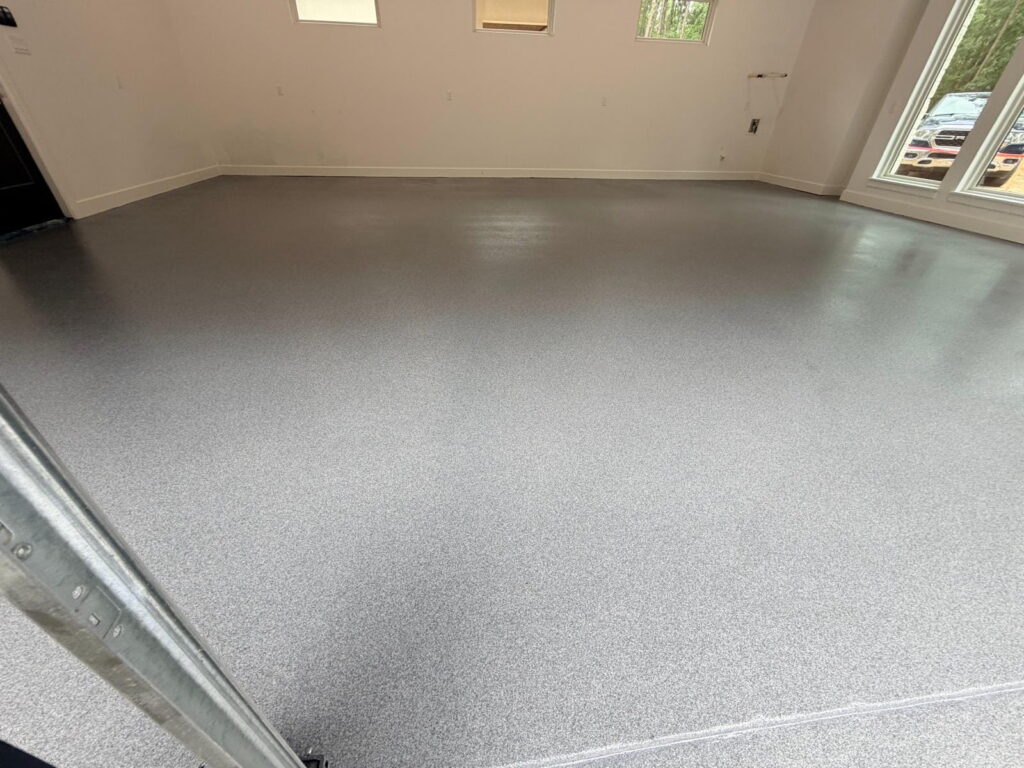
How Quartz Flooring Systems Work
A quartz broadcast system is a multi-layer epoxy floor with colored quartz aggregate embedded into the system. The installation sequence: (1) Diamond grinding and surface preparation; (2) Primer coat; (3) Epoxy base coat — pigmented or clear; (4) Full broadcast of colored quartz aggregate into the wet base coat — the aggregate is thrown across the surface until it’s fully covered; (5) Grout coat of clear epoxy fills in between the quartz particles and locks them in place; (6) Polyaspartic topcoat provides UV stability, hardness, and the final surface characteristics. The result is a surface where the quartz aggregate is fully encapsulated — locked in the epoxy matrix — with a clear topcoat over everything. The quartz provides the texture; the epoxy provides the chemical and mechanical performance; the topcoat provides the surface durability.
Design Options: The Quartz Color System
| Aggregate Blend Category | Visual Character | Best Applications |
|---|---|---|
| Earth tones (sandstone, taupe, sienna) | Warm, natural, residential — like travertine or sandstone | Living rooms, kitchens, Hill Country interiors |
| Gray series (silver, charcoal, slate) | Modern, professional, versatile | Garages, commercial lobbies, offices |
| Multi-color blends (custom combinations) | Terrazzo-inspired, dynamic, colorful | Schools, fitness centers, boutique retail |
| White and cream series | Clean, bright, light-amplifying | Kitchens, healthcare, food service |
| Bold colors (blue, green, red) | Vibrant, branded, high-energy | Sports facilities, branded commercial, children’s areas |
Durability: Why Quartz Outperforms Smooth Epoxy Under Stress
Quartz (silicon dioxide, SiO₂) is one of the hardest naturally occurring minerals, rating 7 on the Mohs hardness scale — harder than most metals. When encapsulated in an epoxy matrix, this aggregate dramatically increases the surface’s resistance to abrasion, impact, and point loads compared to a smooth epoxy film. In high-traffic areas — commercial lobbies, school hallways, gym floors — the quartz system’s aggregate surface distributes stress more effectively than a smooth film, extending the effective service life of the floor. This is why quartz systems are specified for commercial kitchens, loading docks, and any floor where dropped tools, rolling equipment, or high foot traffic are daily realities.
The Safety Standard for Wet Environments
Texas homes and commercial facilities face wet floor conditions regularly: kitchen spills, bathroom use, pool area foot traffic, rain-wet patios. A full quartz broadcast system achieves a wet COF of 0.70–0.85 — significantly above the ADA minimum of 0.60. This isn’t just regulatory compliance; it’s genuine safety. In a kitchen where a family member slips on a wet floor, or a commercial facility where a worker falls and files a workers’ comp claim, the floor’s COF is a documented, measurable factor. CB1 provides COF test documentation for quartz installations on request.
Frequently Asked Questions
How does quartz flooring compare to terrazzo?
Traditional terrazzo — marble or glass chips set in a cement or epoxy matrix, then ground and polished — creates a similar aggregate-in-matrix visual effect at higher cost ($15–$30/sq ft installed). Modern quartz broadcast systems achieve a similar aesthetic at $5–$9/sq ft with comparable durability. For historic buildings or preservation projects where authentic terrazzo is required, that’s the right choice; for new construction or renovation where the goal is the terrazzo aesthetic at reasonable cost, a quality quartz system delivers it.
Can quartz systems be installed outdoors in Texas?
Yes, with UV-stable polyaspartic topcoats (standard in CB1’s exterior specifications). Quartz systems are excellent for covered patios and pool surrounds in the Texas climate — the aggregate provides reliable wet traction, the polyaspartic topcoat handles UV and thermal cycling, and light-colored aggregates keep surface temperatures manageable. Full sun exposure on exterior slabs requires the UV-stable topcoat specification; CB1 uses this as standard on all outdoor installations.
What’s the maintenance difference between a quartz floor and polished concrete?
Both are very low maintenance. Quartz floors require slightly more scrubbing during monthly deep cleaning to clear debris from the aggregate texture. Polished concrete requires periodic re-application of a concrete guard product (every 3–5 years) to maintain stain resistance; quartz topcoats don’t require this. Day-to-day, both are swept and mopped with the same technique and the same neutral pH cleaners.
Is quartz flooring appropriate for a bedroom or carpeted living area conversion?
Yes, including earth-tone and warm quartz blends that create a soft, residential aesthetic appropriate for living spaces. The textured surface is comfortable underfoot — less cold-feeling than polished concrete. The main consideration is acoustic: hard floors are louder than carpet under foot traffic. Area rugs and acoustic ceiling treatment address this in living spaces where noise level matters.
Ready to transform your concrete? Get a free, no-pressure estimate from CB1 Specialty Concrete — San Antonio’s prep-first epoxy and polished-concrete experts, backed by a 15-year warranty.
REQUEST A FREE ESTIMATE
Free Estimate
Want this floor in your space?
We measure, inspect the slab, and give you a real number — no obligation.


