Basements are less common in San Antonio and the Hill Country than in the rest of the country, but properties in Helotes, Boerne, and parts of Alamo Heights with basements often have the most underutilized square footage in the home. That damp, rough, uninviting concrete doesn’t have to stay that way. The right epoxy system can transform a basement slab into a clean, bright, moisture-resistant living space that functions as a home gym, workshop, media room, or storage area — for a fraction of what the space is worth once finished.
The Moisture Challenge in Texas Basements
Moisture drive — water vapor migrating up through the concrete slab from the soil below — is the primary enemy of any floor coating applied to a basement. In the expansive clay soils of the Hill Country and Helotes area, soil moisture levels fluctuate significantly with seasonal rainfall. A coating applied over a slab with active moisture drive will eventually delaminate, blister, or allow mold growth underneath. The solution is not to avoid basement epoxy — it’s to test and address moisture before installing.
CB1 tests every basement slab for moisture vapor emission rate (MVER) using calcium chloride or relative humidity probe methods before any coating recommendation is made. If MVER exceeds the acceptable threshold for the intended system, a moisture vapor barrier coat is specified as the first layer. This is a standard step on basement projects, not an upsell — skipping it is what causes basement floor failures.
Recommended Systems for Texas Basements
| System | Best For | Moisture Tolerance | Cost Range (per sq ft) |
|---|---|---|---|
| Moisture barrier + epoxy + poly topcoat | General living/storage | High (with barrier) | $6 – $9 |
| Moisture barrier + quartz system | Gym, workshop, high-use | High (with barrier) | $7 – $10 |
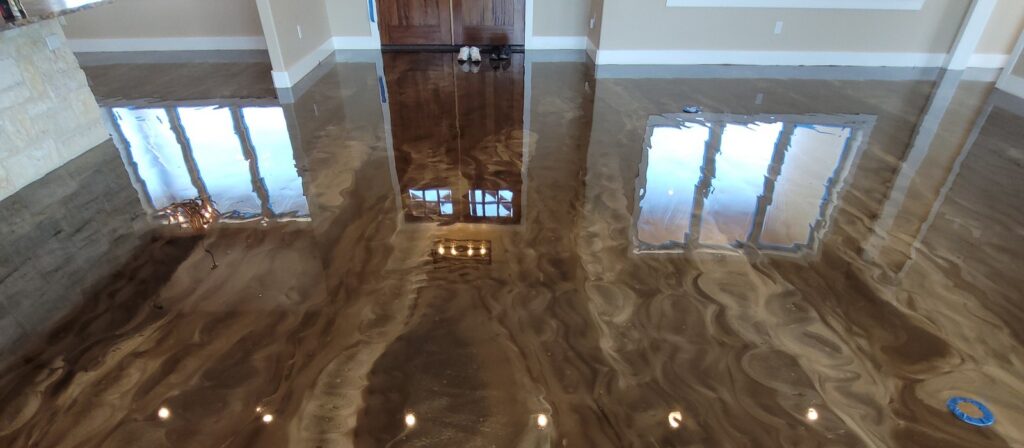
| Moisture barrier + metallic epoxy | Luxury media/living rooms | High (with barrier) | $9 – $13 |
| Standard epoxy (no barrier) | Confirmed dry slabs only | Low | $4 – $6 |
Aesthetic Transformation: Before and After
The visual transformation from a raw basement slab to a finished epoxy floor is dramatic. A light gray or bone-colored base coat with a full-broadcast flake system increases reflectivity significantly — turning a dim, cave-like space into a bright, clean room that feels finished and usable. For homeowners converting basements into home offices or gyms, the floor is often the first step that unlocks the full transformation; walls and ceilings follow.
Installation Considerations for Basements
Basement projects present some unique logistical considerations: ventilation during application is essential (epoxy chemistry produces fumes during installation), access for equipment is sometimes more restricted than in a garage, and humidity levels on install day matter. CB1 schedules basement installations to align with favorable humidity conditions and uses industrial ventilation equipment during the process to maintain safe air quality and optimal cure conditions.
Frequently Asked Questions
How do I know if my basement slab is too wet for epoxy?
The calcium chloride test (ASTM F1869) or relative humidity probe test (ASTM F2170) provides a definitive measurement. CB1 performs this testing before every basement quote. Visual indicators like efflorescence (white mineral deposits), damp spots after rain, or a musty smell all suggest moisture issues that should be tested before committing to a coating system.
Can epoxy flooring help reduce basement humidity?
A sealed epoxy floor reduces evaporative moisture from the slab into the air, which can modestly improve basement humidity levels. It doesn’t replace proper waterproofing or drainage solutions for slabs with active water intrusion — those issues should be resolved at the source before any floor coating is applied.
Is epoxy flooring warm enough for a basement gym or living space?
Concrete is naturally cool, and epoxy doesn’t add thermal mass. For basement spaces used as living areas, area rugs or underfloor radiant heating can address temperature comfort. The epoxy floor itself is fine — it just doesn’t insulate.
How do I prepare my basement for the installation?
Clear the space completely (CB1 cannot work around stored items), ensure the space is accessible, and plan for 24–72 hours out of the basement after the final coat. If there are floor drains, inform your CB1 installer so they can be protected during the coating process.
Ready to transform your concrete? Get a free, no-pressure estimate from CB1 Specialty Concrete — San Antonio’s prep-first epoxy and polished-concrete experts, backed by a 15-year warranty.
REQUEST A FREE ESTIMATE
Free Estimate
Want this floor in your space?
We measure, inspect the slab, and give you a real number — no obligation.


