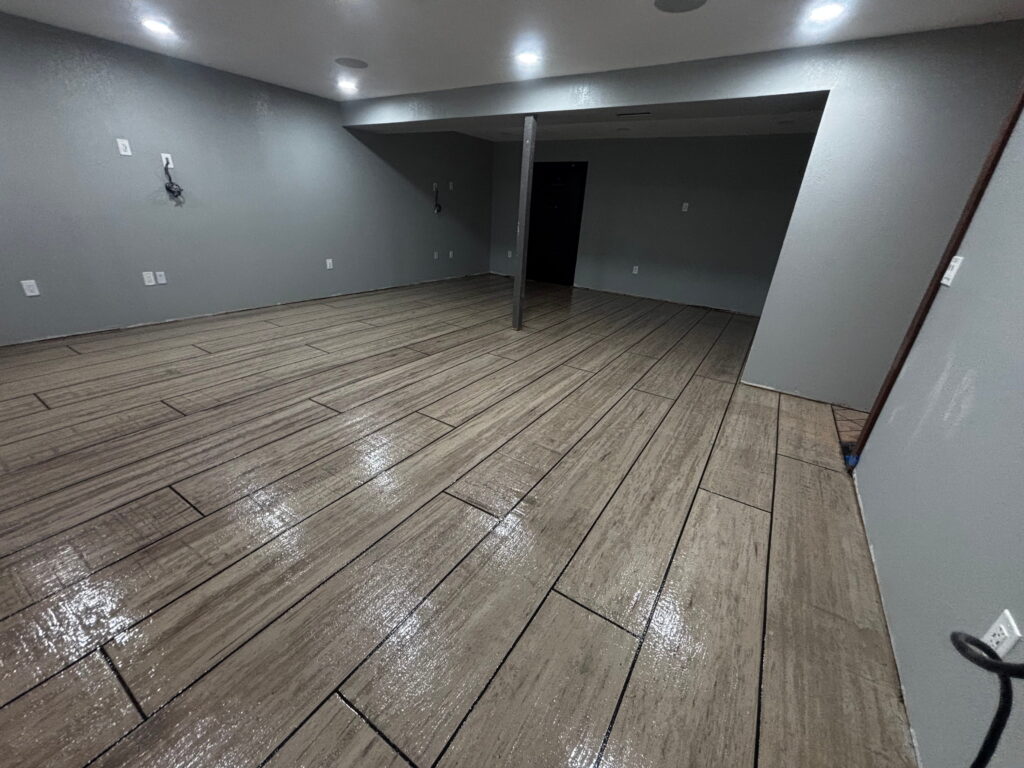
Some of the most dramatic flooring transformations CB1 delivers in Shavano Park and across the San Antonio metro don’t involve pouring new concrete or installing a new floor system from scratch. They start with concrete that homeowners thought was destined for demolition — cracked, spalled, stained, outdated — and they end with a beautiful, durable floor that will outlast the structure around it. Concrete overlay systems make this possible at a fraction of the cost of demolition and replacement. Here’s how they work, what types exist, and how to know if your concrete is a good candidate.
Types of Concrete Overlay Systems
| Overlay Type | Thickness | Best Problem It Solves | Cost/sq ft (overlay only) |
|---|---|---|---|
| Skim coat / micro-topping | 1/16″ – 3/16″ | Surface blemishes, old coating removal, light unevenness | $2 – $4 |
| Self-leveling overlay | 3/16″ – 3/4″ | Uneven, out-of-level slabs; high spots and depressions | $3 – $6 |
| Decorative stamp overlay | 3/8″ – 1/2″ | Dated concrete; want stone/brick appearance | $5 – $9 |
| Polymer-modified mortar | 1/4″ – 3/4″ | Structural surface repair; spalled or pitted slabs | $4 – $7 |
| Epoxy slurry overlay | 3/16″ – 3/8″ | Bridge between damaged slab and epoxy top system | $3 – $5 |
The Overlay Candidate Assessment
Not every damaged concrete surface is a good overlay candidate, and honest assessment before committing to an overlay saves significant money and frustration. Good candidates: slabs with surface spalling, scaling, or roughness but sound underlying structure (no heaving, no through-slab movement, no significant structural cracks); slabs with old coating failure that’s been removed to bare concrete; slabs that are level overall but have surface quality issues. Poor candidates: slabs with active structural cracks that continue moving (the overlay will crack in the same location); slabs with significant heaving from soil failure or tree root intrusion; slabs with active water intrusion from below (must be mitigated before any overlay). CB1 performs a thorough slab assessment before recommending any overlay application.
The Overlay + Epoxy Combination
In most residential and commercial applications, an overlay is not the final finish layer — it’s the foundation for an epoxy coating system. The overlay restores the slab to a sound, even surface; the epoxy coating system provides the protection, chemical resistance, and aesthetic that the finished floor requires. This combination — overlay plus epoxy — is CB1’s recommendation for significantly damaged slabs that don’t require full replacement: it’s more cost-effective than demolition, more durable than overlay alone, and achieves the full performance and aesthetic of a new installation.
Cost Savings vs. Replacement: A Real Example
A Shavano Park homeowner with a 700 sq ft patio slab showing extensive surface spalling and several cosmetic cracks was quoted $18,000 for slab removal and replacement. CB1’s assessment confirmed the underlying structure was sound — no heaving, no through-slab movement. A polymer-modified overlay ($4,500) followed by a polyaspartic broadcast system ($3,800) delivered a new, beautiful, durable patio surface for $8,300 total — saving $9,700 and avoiding the two-week disruption of demolition and concrete curing. The combined overlay-and-coating system carries a full 15-year warranty.
Frequently Asked Questions
Will an overlay hide existing cracks completely?
Active cracks — those that continue to move with soil movement, thermal cycling, or structural settling — will eventually telegraph through an overlay. These cracks must be treated with flexible polyurethane filler or crack isolation membrane before overlay application. Dormant cracks (no movement for at least 12 months) can be filled and overlaid with good long-term results. CB1 identifies crack type during assessment and specifies appropriate treatment.
How long does a concrete overlay last?
A properly bonded overlay on a prepared, sound slab lasts as long as the concrete beneath it — effectively indefinitely — provided it’s protected by a quality coating system. Overlays that fail prematurely almost always failed at the bond line due to contaminated substrate, insufficient prep, or moisture from below. With proper preparation, an overlay is a permanent repair.
Can I apply an overlay to my concrete driveway to improve its appearance?
Yes, with appropriate overlay product selection. Exterior overlays require flexibility additives and UV-stable topcoats to handle Texas thermal cycling and UV exposure. Driveways also face vehicle traffic that interior residential slabs don’t — overlay thickness and topcoat specification should be selected accordingly. CB1 specifies exterior overlay systems appropriate for vehicle traffic on every driveway project.
Does adding an overlay height affect existing door clearances or transitions?
At 3/16–3/8″ typical thickness for most residential overlays, door clearances are usually unaffected. In tight situations — particularly interior door bottoms — CB1 measures and confirms clearance during the consultation and will advise if any door adjustment is needed before the overlay is applied.
Ready to transform your concrete? Get a free, no-pressure estimate from CB1 Specialty Concrete — San Antonio’s prep-first epoxy and polished-concrete experts, backed by a 15-year warranty.
REQUEST A FREE ESTIMATE
Free Estimate
Want this floor in your space?
We measure, inspect the slab, and give you a real number — no obligation.


