
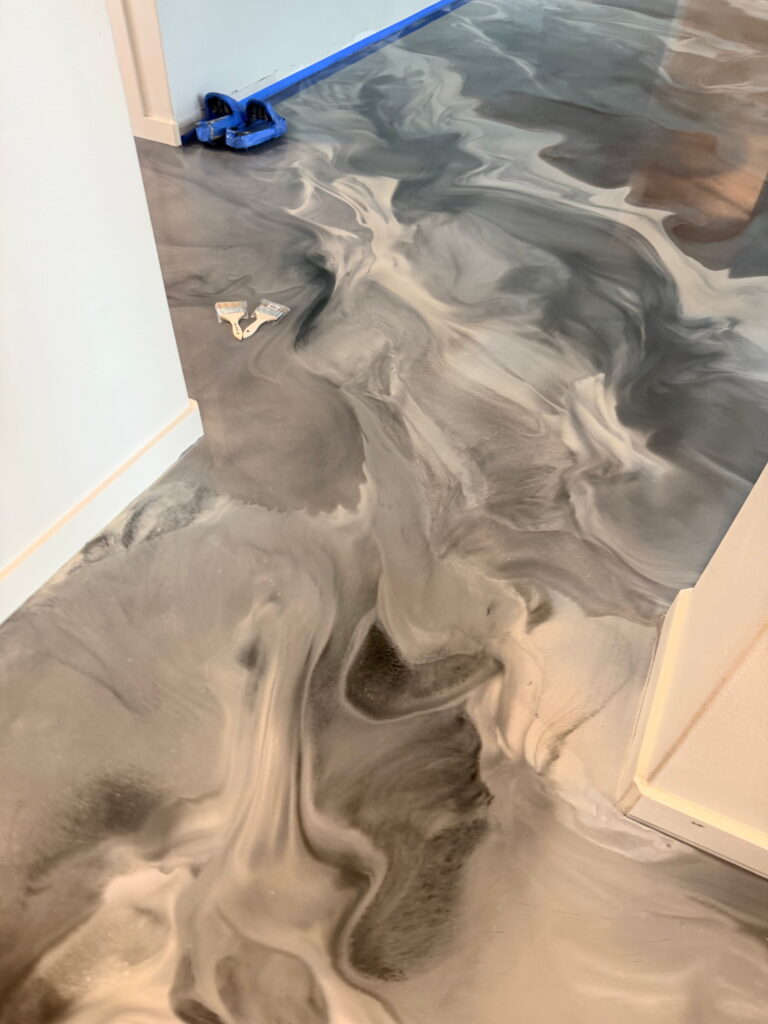
The idea of epoxy flooring in a living room or bedroom still surprises some homeowners in Boerne and across the Hill Country — these systems have a garage reputation that doesn’t fully capture what modern decorative concrete can do in a residential living space. The reality is that polished concrete, decorative metallic epoxy, and warm-toned quartz systems have been featured in Architectural Digest, House Beautiful, and the portfolio of every serious Texas interior designer. When done correctly, they’re among the most beautiful and livable floors available. When done poorly — wrong color, wrong sheen, no thought to the living experience — they’re cold, hard, and unforgiving. Here’s how to do it correctly.
System Selection by Living Space Zone
| Space | Key Considerations | Recommended System | Sheen |
|---|---|---|---|
| Main living / great room | Aesthetics, comfort, acoustic, foot traffic | Polished concrete with warm dye, or decorative epoxy | Matte or satin |
| Kitchen | Spill resistance, slip resistance, seamless (no grout) | Quartz broadcast or polished concrete | Satin |
| Dining area | Chair leg resistance, cleanability, aesthetics | Polished concrete or decorative epoxy | Satin or matte |
| Master bedroom | Warmth perception, comfort underfoot, aesthetics | Polished concrete (warm dye) with area rugs | Low sheen / matte |
| Home office | Rolling chair compatibility, acoustic, professional | Polished concrete or medium-sheen epoxy | Satin |
| Mudroom / entry | Dirt-hiding, durability, easy cleaning | Quartz or flake epoxy (dark blend) | Satin |
Addressing the Comfort Concerns
The legitimate concerns about concrete floors in living spaces are thermal comfort and acoustic performance — and both have straightforward solutions. Temperature: Concrete feels cooler than carpet at the same room temperature, especially on cold mornings. Area rugs in seating areas and bedrooms address this completely. Radiant floor heating paired with polished concrete is the premium solution: the thermal mass makes the system more efficient, and the floor feels warm underfoot. Acoustics: Hard floors amplify footstep noise and room reverberation. Acoustic ceiling treatment, fabric upholstery, and area rugs manage this without compromising the floor choice. Many homeowners find that the acoustic environment of a well-designed hard-floor room is actually preferable to carpet — less muddiness, more clarity in conversation and audio.
The Design Case for Living Space Concrete
In Boerne’s Hill Country homes, where the design language often pulls from natural stone, raw wood, and organic materials, polished concrete in warm sand or greige tones creates a seamless connection between interior and exterior that manufactured flooring products struggle to achieve. The floor reads as an extension of the natural landscape rather than a product laid over it. Combined with the thermal mass benefit (important in passive solar Hill Country homes) and the near-zero maintenance, polished concrete makes a compelling case as the defining interior surface in well-designed Texas residential spaces.
What Living Space Concrete Installation Involves
Unlike garage and commercial installations, living space projects require more detailed planning around furnishings, staging, and room-by-room sequencing. CB1 works with homeowners to phase living space installations so rooms are functional throughout: grinding, polishing, and coating one room while another is in use, working toward complete installation zone by zone. The typical living space project takes 4–7 days depending on total area and system complexity. Furniture protection and dust containment are priority considerations that CB1 manages with containment barriers and protective coverings.
Frequently Asked Questions
Will my furniture leave marks on a polished concrete or epoxy floor?
Heavy furniture with small contact feet can leave impressions over time in any floor system. Felt pads under all furniture legs prevent marks on polished concrete. Rolling furniture or chairs benefit from soft-wheel casters. Heavy stationary pieces (bookshelves, pianos) on equipment mats or furniture coasters distribute the load. These are simple, inexpensive precautions that protect any premium floor, not just concrete.
How does concrete flooring affect furniture arrangement flexibility?
No differently than tile or hardwood. You can rearrange furniture on a concrete floor freely — unlike carpet, there are no permanent pile compression marks. The one consideration is furniture protection: move heavy pieces on furniture sliders rather than dragging, and use felt pads to prevent scratch marks during repositioning.
Is there a risk that my living space concrete floor will look like a garage floor?
Only if you specify a garage floor system: solid gray, high gloss, industrial film build. A living space specification uses warm or designer color concrete dye or tinted epoxy, matte or satin sheen, and potentially a decorative technique (metallic, texture, or aggregate effect) that distinguishes it entirely from a garage application. The result looks nothing like a garage floor — it looks like a premium interior surface that happens to be concrete.
Can I add in-floor heating to an existing concrete floor before polishing it?
Retrofitting radiant heating into an existing slab is possible but requires saw-cutting channels for the tubing — a significant construction project. For renovation projects where in-floor heating is desired, it’s most cost-effective to install the heating system and a concrete overlay (to bury the tubing) before the polish or coating system is applied. CB1 coordinates with mechanical contractors on these projects.
Ready to transform your concrete? Get a free, no-pressure estimate from CB1 Specialty Concrete — San Antonio’s prep-first epoxy and polished-concrete experts, backed by a 15-year warranty.
REQUEST A FREE ESTIMATE
Free Estimate
Want this floor in your space?
We measure, inspect the slab, and give you a real number — no obligation.


