
In Helotes and across the Hill Country, where connection to the natural environment is part of the lifestyle and aesthetic, polished concrete has found an enthusiastic audience — not just for its modern appearance but for what it doesn’t require. No synthetic coatings. No replacement cycles every 10–15 years. No adhesives, no backing materials, no landfill at the end of its life. Just the concrete that’s already there, refined into something beautiful. In a flooring market full of products that market environmental credentials while delivering minimal actual environmental benefit, polished concrete’s sustainability claims are real.
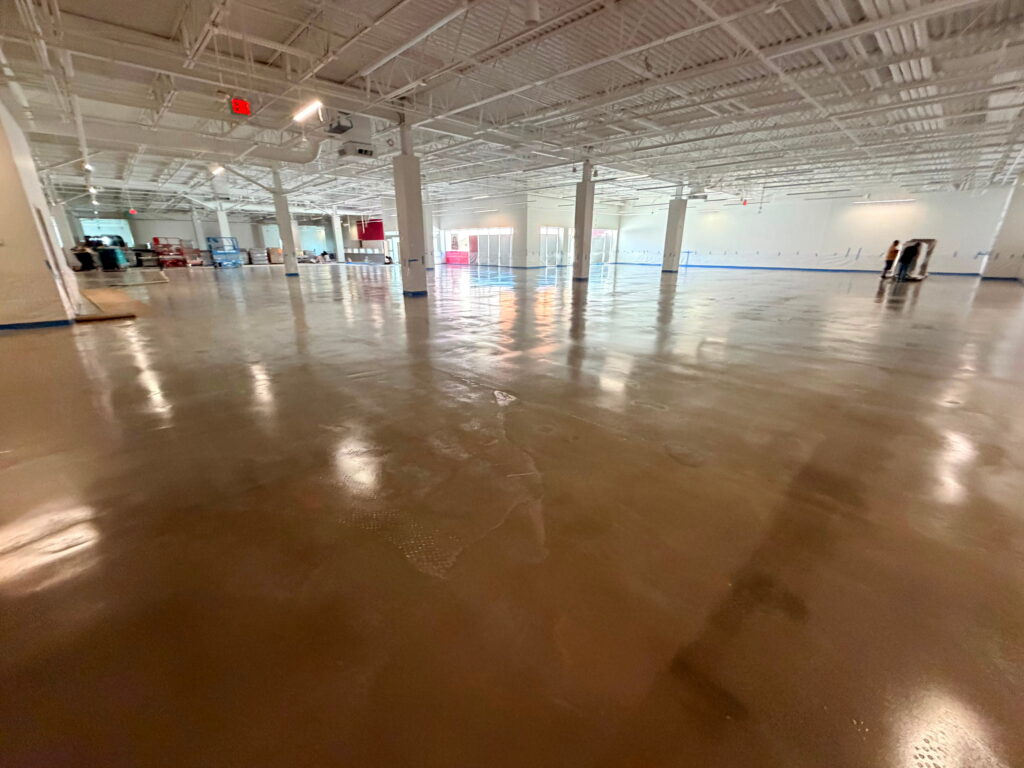
Why Polished Concrete Is Genuinely Eco-Friendly
| Environmental Factor | Polished Concrete | Vinyl / LVT | Carpet | Ceramic Tile |
|---|---|---|---|---|
| New material required | None — existing slab | Yes — PVC-based synthetic | Yes — synthetic fibers | Yes — ceramic + adhesive |
| VOC emissions (installation) | None — dry mechanical process | Moderate (adhesives) | High (adhesives, off-gassing) | Moderate (adhesives, grout) |
| Replacement frequency | None — indefinite service life | Every 10–15 years | Every 5–10 years | Tile: 20+ years; grout: 7–10 yr |
| Landfill contribution | None | High (non-recyclable PVC) | High (synthetic fiber) | Moderate (ceramic) |
| Energy use in maintenance | Very low (dust mop + water) | Low | High (vacuuming, steam clean) | Moderate (grout cleaning) |
| Thermal mass (passive cooling) | High — helps regulate interior temp | None | None | Moderate |
The Thermal Mass Advantage in Texas
Polished concrete doesn’t just look good in a Hill Country home — it works with the climate. Concrete has high thermal mass: it absorbs heat during the day and releases it slowly as temperatures drop at night, moderating interior temperature swings. In Helotes and Boerne‘s Hill Country homes, where passive design strategies reduce air conditioning load, a polished concrete floor functions as a thermal flywheel — absorbing solar gain through south-facing windows in winter and staying cool under insulated shading in summer. This is a real energy benefit, measurable in reduced HVAC load, that synthetic flooring products cannot provide.
The LEED Contribution
For homeowners pursuing LEED or Green Globes certification for new construction or major renovation, polished concrete contributes to multiple credit categories: Materials and Resources (using the existing concrete slab instead of adding new flooring material), Indoor Air Quality (zero VOC from mechanical polishing, no adhesives), and Innovation credits for exceeding standard practice. CB1 provides material documentation for LEED projects and has experience with the documentation requirements for residential and commercial green building certifications.
Aesthetics: A Floor That Ages Well
One of polished concrete’s most underappreciated qualities is that it ages gracefully. Unlike synthetic flooring that shows wear patterns, seam failures, and color fading over years, polished concrete develops character over time — a lived-in patina that many homeowners find more beautiful than the original surface. The mechanical process of polishing penetrates and reforms the concrete itself, so there’s no film to wear away or surface to degrade. Annual or biennial application of a concrete guard product maintains the stain resistance without the full re-polish treatment.
Frequently Asked Questions
Is polished concrete cold and uncomfortable to stand on in a Hill Country home?
Concrete is cooler than carpet at the same room temperature, but no cooler than tile or stone. In Hill Country homes where interior temperatures are well-regulated, most occupants find polished concrete comfortable. Area rugs in living areas and bedrooms address any thermal comfort concerns. The thermal mass benefit — the floor feeling cool in summer — is often experienced as a comfort positive rather than a negative in Texas.
Can polished concrete be refinished if it gets scratched or damaged?
Yes — one of polished concrete’s unique advantages is that surface damage can be mechanically re-polished at the affected area without the visible repair line that any coating system leaves. Deep scratches or abrasion can be brought back through targeted re-polishing of the affected section. Full re-polishing of the entire floor restores original appearance after decades of use.
Does polished concrete work over radiant heating in a Texas home?
Yes, and it works well — concrete’s thermal mass makes it an ideal companion to radiant floor heating, more efficient than any lightweight flooring material because it stores and releases heat steadily rather than warming and cooling quickly with the heating cycle. CB1 adjusts installation protocols for slabs with embedded radiant heating.
Is polished concrete appropriate for a Texas home with pets?
Yes. Polished concrete resists pet stains (no grout lines to harbor odors), is easy to clean, and doesn’t harbor pet dander the way carpet does — a significant advantage for allergy-prone households. The surface may be slightly slippery for older dogs with mobility issues; a matte finish with a light concrete guard treatment addresses this. Area rugs in pet resting areas are common and easy to wash.
Ready to transform your concrete? Get a free, no-pressure estimate from CB1 Specialty Concrete — San Antonio’s prep-first epoxy and polished-concrete experts, backed by a 15-year warranty.
REQUEST A FREE ESTIMATE
Free Estimate
Want this floor in your space?
We measure, inspect the slab, and give you a real number — no obligation.


