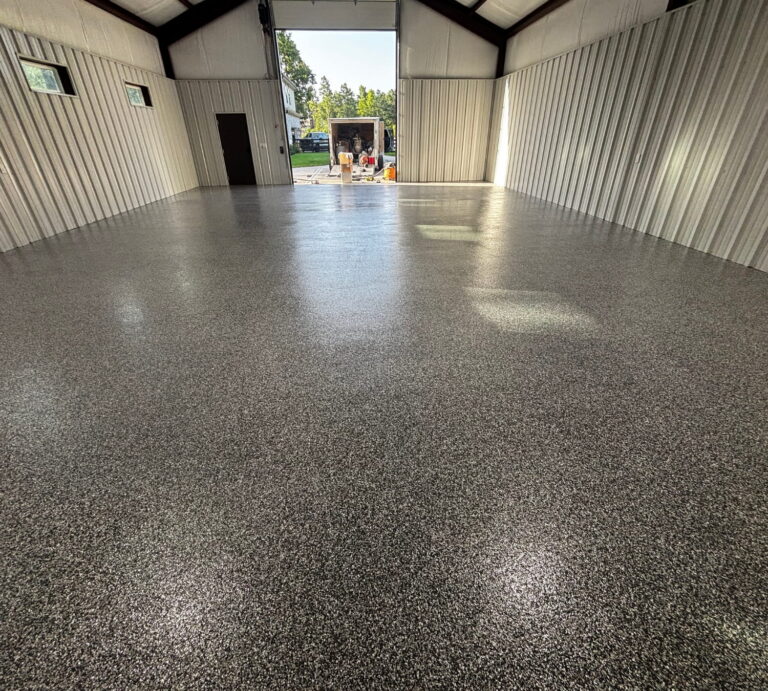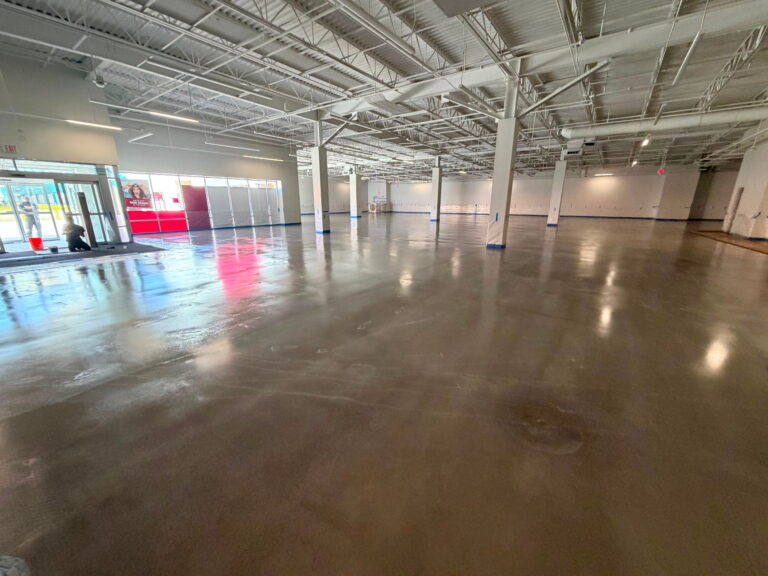
The modern office floor is carrying more strategic weight than ever. Post-pandemic, companies competing for top talent in San Antonio’s growing Stone Oak professional corridor — where medical, financial, and tech firms cluster — understand that office environment is a direct factor in both talent attraction and retention. A worn, tired office floor signals underinvestment in the people who work there. A polished concrete or premium epoxy floor signals the opposite: this is a company that takes quality seriously, from the product to the workspace. That signal is worth making.
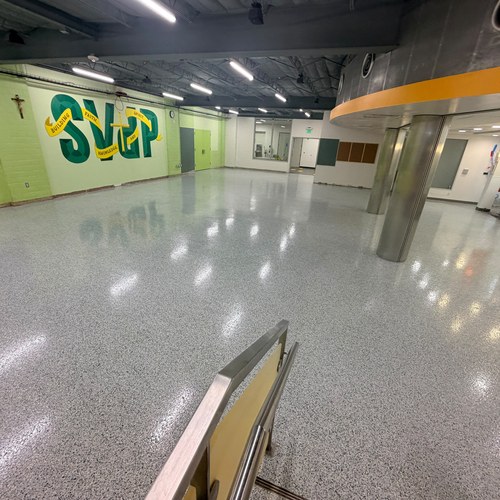
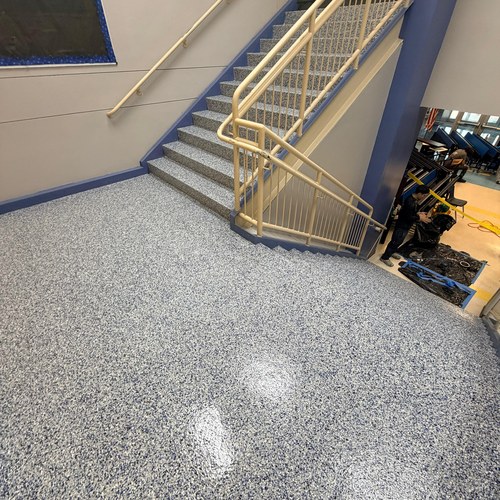
Office Flooring Zones and Their Requirements
| Zone | Primary Need | Recommended Option |
|---|---|---|
| Reception / lobby | Stunning first impression, durability, easy clean | Polished concrete, metallic epoxy, or decorative overlay |
| Open office / workstations | Rolling chair compatibility, acoustic neutrality, cleanable | Polished concrete (medium sheen) or LVT |
| Conference rooms | Prestige, audio considerations, cleanliness | Polished concrete or quality epoxy with rug area |
| Break room / kitchen | Slip resistance when wet, easy cleaning, stain resistance | Quartz epoxy or polished concrete |
| Server room / IT closet | Static control, cleanability, dust-free | Conductive or dissipative epoxy |
| Corridors / circulation | Durability, way-finding, easy maintenance | Polished concrete with concrete dye accents |
Polished Concrete: The Dominant Office Flooring Choice
Polished concrete has become the dominant premium flooring choice for modern offices because it achieves something few other surfaces do: it looks expensive while actually being one of the most cost-effective long-term options available. Installation runs $3–$7/sq ft. Annual maintenance costs are $0.05–$0.25/sq ft — versus $1.50–$3.00/sq ft for VCT strip-and-wax or $0.75–$1.50/sq ft for commercial carpet cleaning programs. Over a 10-year occupancy, polished concrete almost always has the lowest total cost of ownership of any commercial flooring option.
Acoustic Considerations for Open Offices
Hard floors — concrete, epoxy, tile — reflect sound rather than absorbing it. In open-plan offices, this can contribute to noise levels that affect focus and productivity. The right approach isn’t to avoid hard floors but to balance them with acoustic ceiling treatments, panel systems, soft furnishings, and area rugs in key conversation areas. Many of the most productive and desirable offices in Austin and San Antonio use polished concrete throughout with strategic acoustic zoning — not carpet throughout.
The Employee Experience Argument
Gallup research consistently shows that physical workspace quality is among the top factors in employee engagement and retention, particularly for knowledge workers. A beautifully designed office with quality finishes — including the floor — signals that leadership values the people who work there. The cost of a quality floor installation is trivial compared to the cost of losing and replacing a skilled employee, which HR research pegs at 50–200% of annual salary depending on seniority.
Frequently Asked Questions
Are rolling office chairs hard on polished concrete?
Standard hard-wheel office chairs can leave marks on polished concrete over time. Soft-wheel (polyurethane) chair casters are readily available and recommended for hard floor surfaces. Alternatively, anti-fatigue mats or area rugs under workstations protect both the floor and the occupant. CB1 advises on caster compatibility as part of the post-installation briefing.
How loud is polished concrete in an open office?
Sound levels on polished concrete depend heavily on ceiling height, ceiling treatment, and the amount of soft furnishings in the space. Offices with acoustic ceiling tiles, panel systems, and fabric-covered furniture typically achieve comfortable noise levels with hard floors. CB1 can provide references to acoustic consultants for large open-plan installations.
Can office flooring be installed in phases while staff continue working?
Yes. CB1 regularly phases office installations — coating one wing or floor at a time while staff operate from another area. Diamond grinding produces dust that requires temporary barriers, which CB1 provides. Evening and weekend scheduling is also available to minimize disruption.
What is the ROI timeline for a polished concrete office floor?
Given the maintenance cost differential between polished concrete and VCT or commercial carpet, most office floors reach break-even within 3–5 years. Beyond that, the ongoing maintenance savings represent direct cost reduction. The talent-retention and client-impression benefits add further value that’s harder to quantify but consistently reported by building managers.
Ready to transform your concrete? Get a free, no-pressure estimate from CB1 Specialty Concrete — San Antonio’s prep-first epoxy and polished-concrete experts, backed by a 15-year warranty.
REQUEST A FREE ESTIMATE
Free Estimate
Want this floor in your space?
We measure, inspect the slab, and give you a real number — no obligation.