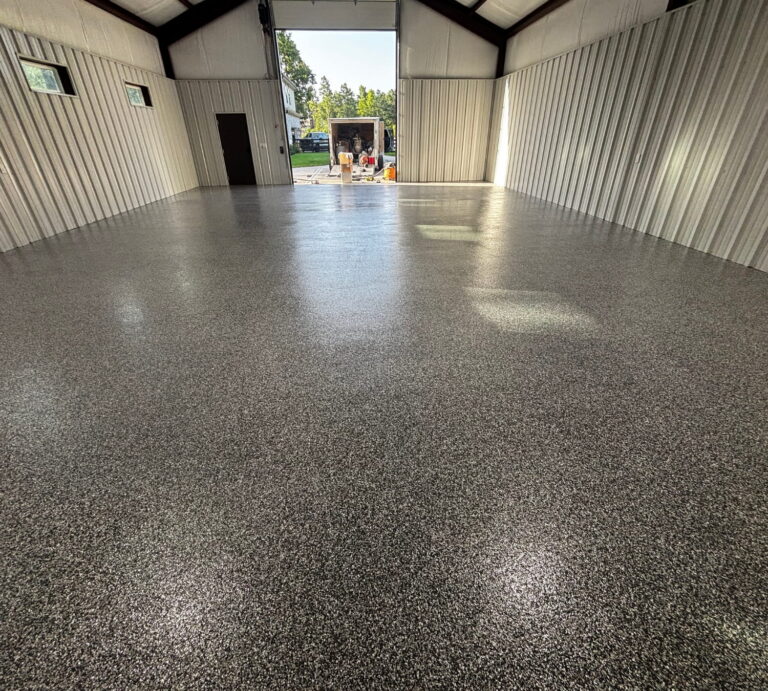
Commercial epoxy flooring projects involve more variables than residential installations, and accurate budgeting requires understanding what drives cost at the commercial scale. Property managers, facility managers, and GCs working in San Antonio need real numbers — not ranges so wide they’re useless. This guide breaks down commercial epoxy flooring cost by system type, facility category, and project size, with honest guidance on what to expect at each price point.
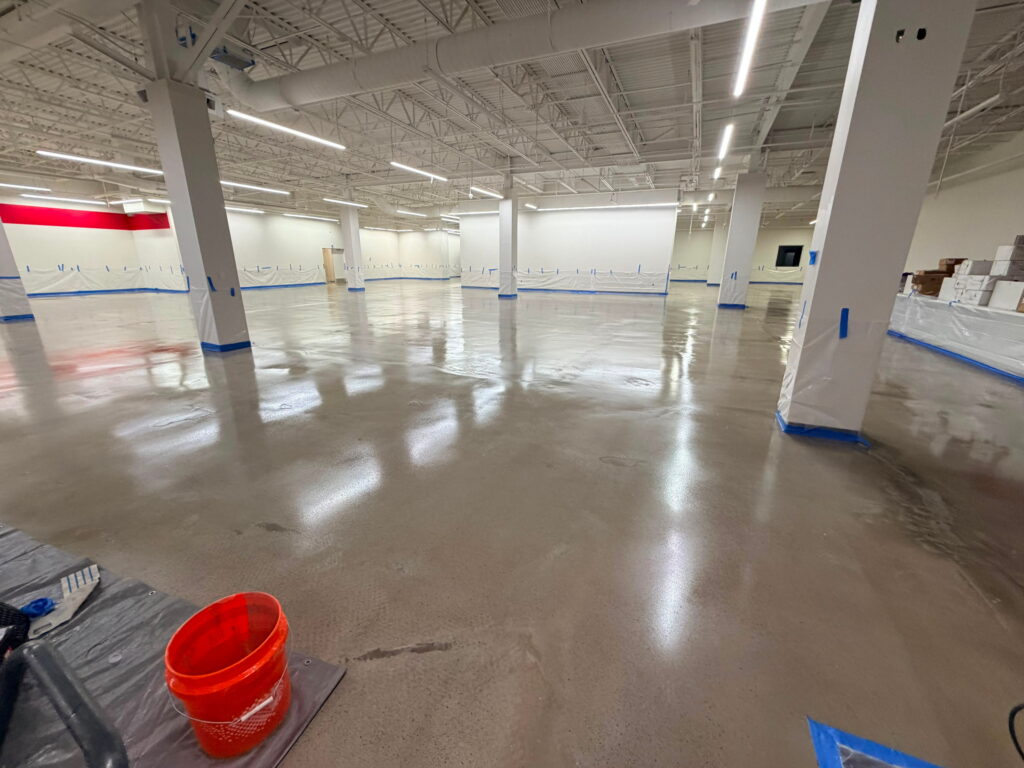
Commercial Epoxy Flooring Cost by System Type (2026)
| System | Cost per sq ft (installed) | Typical Application |
|---|---|---|
| Standard solid-color epoxy (3-coat) | $4 – $6 | Warehouses, light industrial, storage |
| Broadcast quartz or flake epoxy | $6 – $9 | Retail, commercial kitchen, office |
| High-build industrial epoxy | $7 – $10 | Manufacturing, automotive, heavy traffic |
| Urethane mortar system | $10 – $14 | Food service, chemical processing |
| Polished concrete | $3 – $7 | Retail, office, hospitality |
| Metallic epoxy (commercial) | $8 – $12 | Showrooms, luxury retail, lobbies |
How Project Size Affects Cost Per Square Foot
Commercial epoxy pricing benefits from economies of scale: the mobilization costs (equipment transport, site setup, crew travel) are relatively fixed regardless of project size, so larger projects yield lower per-square-foot costs. A 1,000 sq ft retail store and a 25,000 sq ft warehouse require the same planning effort but very different material quantities and application time. The $4–$6/sq ft range for standard industrial epoxy applies most accurately to projects above 5,000 sq ft; smaller commercial projects often run $6–$8/sq ft for the same system.
Surface Condition: The Biggest Variable
Commercial slabs in San Antonio’s industrial parks and strip centers vary enormously in condition. A newly poured slab in a construction-phase installation requires standard prep. A 20-year-old warehouse floor with oil contamination, previous failed coatings, and surface damage may require 2–3 days of additional preparation before a coating can be applied. CB1 always conducts an on-site assessment before quoting and includes any additional prep costs in the written proposal — so there are no surprises after work begins.
Budgeting for a Phased Commercial Installation
Many commercial clients in San Antonio cannot shut down their operations for a full floor installation. Phased installation — coating sections of the facility while others remain operational — adds some project coordination cost but allows the business to continue functioning. For phased projects, budget an additional 10–15% over the base quote to account for more complex logistics, additional masking, and the cost of mobilizing and demobilizing multiple times.
What Should Always Be Included in a Commercial Quote
A professional commercial epoxy quote should include: site assessment and moisture testing, all surface preparation (diamond grinding, shot blasting, crack repair), primer and base coat(s), decorative or functional broadcast (if applicable), topcoat, line marking (if specified), site cleanup, and the warranty terms. If any of these are absent from a quote, ask specifically — and if they’re described vaguely, ask for specifics before signing anything.
Frequently Asked Questions
Is commercial epoxy flooring cost tax-deductible?
In most cases, commercial flooring is a depreciable capital improvement to a business property, and accelerated depreciation under Section 179 may apply. Consult your CPA for specific guidance — CB1 provides detailed invoicing that supports depreciation documentation.
How does commercial epoxy cost compare to polished concrete for retail?
Polished concrete runs $3–$7/sq ft depending on the level of polish and any dye or stain treatment — often less than a full epoxy system. For retail spaces where the aesthetic is modern-industrial and the concrete slab is in good condition, polished concrete frequently provides better ROI than epoxy at scale. CB1 can quote both systems for direct comparison.
Do you offer competitive pricing for multi-location commercial clients?
Yes. Clients with multiple San Antonio area locations — franchises, property management firms, commercial real estate operators — can discuss volume pricing during the initial consultation.
What payment terms does CB1 offer for commercial projects?
Standard commercial terms are a deposit at project acceptance, progress payment at substantial completion, and final payment after the walkthrough. CB1 can accommodate net-30 invoicing for qualified commercial accounts with established relationships.
Ready to transform your concrete? Get a free, no-pressure estimate from CB1 Specialty Concrete — San Antonio’s prep-first epoxy and polished-concrete experts, backed by a 15-year warranty.
REQUEST A FREE ESTIMATE
Free Estimate
Want this floor in your space?
We measure, inspect the slab, and give you a real number — no obligation.